Table of Contents
Understanding Faux Finishers and High-End Plaster Showers in Los Angeles
A faux finisher is a decorative artisan who uses specialized paints and plasters to replicate natural stone, marble, and aged textures. This craft goes beyond standard painting, creating surfaces that mimic authentic materials with remarkable depth and realism.
We at Faux Finishes Los Angeles extend this artistry into high-end waterproof plaster systems designed for showers and wet areas. Our team applies authentic lime-based finishes including tadelakt plaster, micro cement showers, and Venetian plaster -- each offering distinct textures from matte stone to polished marble effects. With ten years of experience and more than 350 showers completed across the greater Los Angeles area, our trained artisans work with lime putty and marble dust to achieve durable, mildew-resistant surfaces that transform bathrooms into spa-like retreats.
As members of the National Association of the Remodeling Industry (NARI), we follow professional standards that prioritize proper substrate preparation, waterproofing integrity, and lasting beauty. We bring the same craftsmanship to faux finish painting Los Angeles as we do to custom tadelakt showers and Venetian plaster walls, ensuring every finish reflects our commitment to detail.
If you're considering a luxury plaster shower, the best next step is to book an on-site inspection and written estimate. Our consultants assess your space, recommend the ideal plaster system, and provide a personalized plan tailored to your home's unique conditions. Understanding how these systems differ is the first step before planning your shower remodel.
Results may vary based on materials, substrate, and workmanship, so we advise obtaining an on-site inspection and written estimate before relying on website descriptions. For properties built before 1978, we follow EPA RRP lead-safe work practices and use certified contractors where required. Please consult a qualified contractor for maintenance and care recommendations.
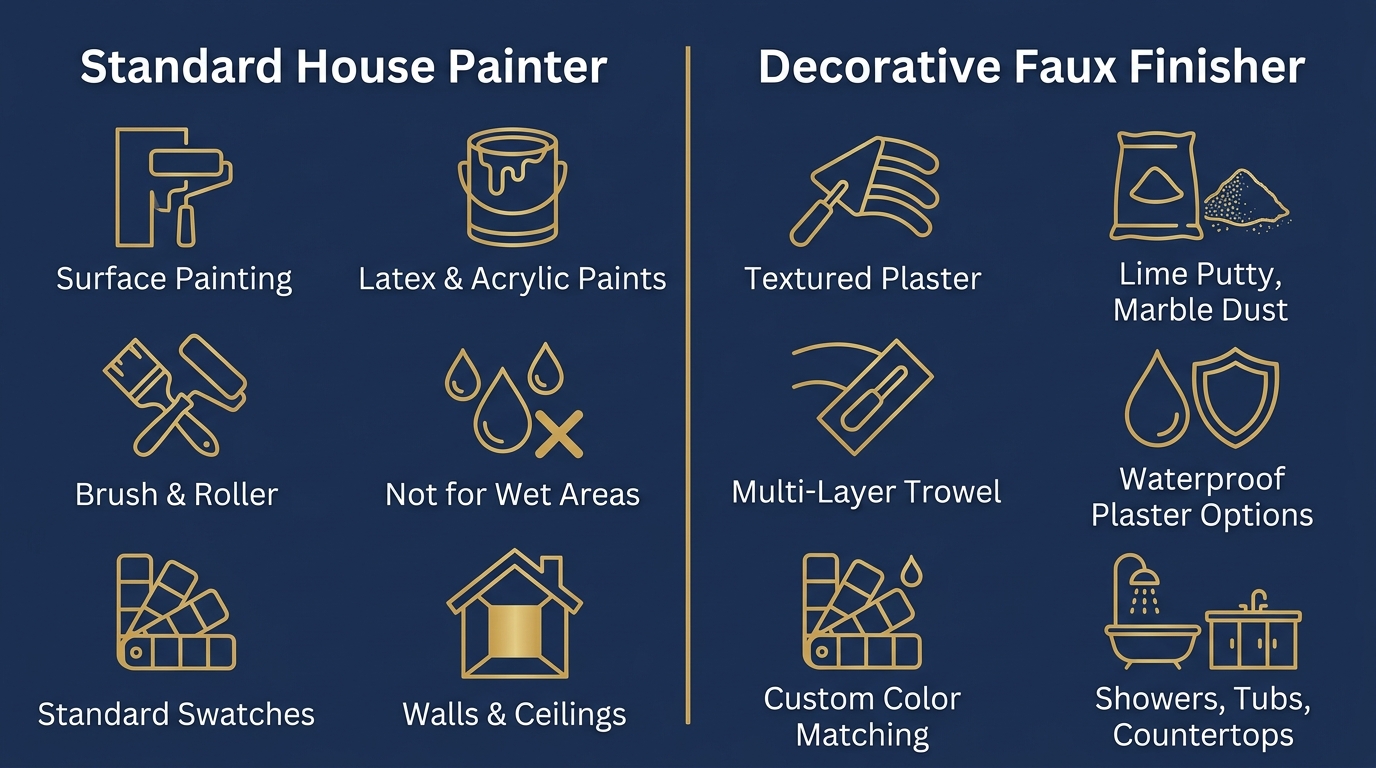
Two very different professionals can be behind your walls: a standard house painter and a decorative faux finisher. A standard painter's primary focus is applying paint to walls and ceilings, using latex/acrylic paints and primers applied by roller, brush, or spray. In contrast, a faux finisher works with specialty materials--lime putty, marble dust, Venetian plaster, microcement, and tinting agents--applied in multiple trowel layers and finished by burnishing or polishing. While a painter works from standard color swatches, a decorative faux finisher achieves custom color matching and high-polish marble effects. The project scope also diverges: standard painters tackle walls and ceilings, whereas faux finishers commonly create waterproof finishes in bathrooms, showers, tubs, countertops, and on feature walls.
| Aspect | Standard House Painter | Decorative Faux Finisher |
|---|---|---|
| Primary Focus | Applying paint to surfaces | Creating textured, layered, waterproof plaster finishes |
| Materials | Latex/acrylic paints, primers | Lime putty, marble dust, microcement, tinting agents |
| Techniques | Roller, brush, spray | Multi-layer trowel application, burnishing, polishing |
| Wet Area Suitability | Not for constant moisture exposure | Waterproof options like tadelakt and microcement |
| Customization | Standard color swatches | Custom color matching, high-polish marble effects |
| Typical Projects | Walls, ceilings | Bathrooms, showers, tubs, countertops, feature walls |
These differences in focus, materials, and wet-area suitability explain why a standard painter cannot meet the demands of a waterproof plaster shower. Standard latex paints are not designed for constant moisture exposure, making a house painter an unsuitable choice for a shower. Waterproof plaster options such as tadelakt and microcement, applied by a trained faux finisher, create durable, mildew-resistant surfaces that perform in wet environments. For a homeowner in search of faux finishes los angeles, this is why hiring a specialist matters. Only a decorative faux finisher has the hands-on experience and material knowledge to achieve a long-lasting, waterproof plaster shower.
Results may vary based on materials, substrate and workmanship. We recommend consulting a qualified contractor to confirm suitability, maintenance, and care requirements, and obtaining an on-site inspection and written estimate before relying on website descriptions. As the National Association of the Remodeling Industry (NARI) underscores, specialty finishes and waterproof plaster showers should be installed by trained, qualified craftsmen--not a general house painter.
Comparing Plaster Finishes for Showers: Venetian, Microcement, Tadelakt, and Marmorino
As a Los Angeles faux finisher, we help homeowners navigate the options between Venetian plaster, microcement, tadelakt, and marmorino for shower walls. Each finish offers a distinctive aesthetic, but their real-world performance in a wet environment depends on application, waterproofing, and ongoing maintenance.
Venetian Plaster: Waterproofing Challenges and Solutions
Venetian plaster is a breathable, lime-based finish known for polished depth. Because it is naturally porous, it must be sealed with a compatible wax or sealer before use in a shower. In Los Angeles bathrooms, properly sealed Venetian plaster can work on shower walls, but it requires periodic resealing to maintain its moisture barrier. It is not recommended for shower floors, where standing water can penetrate the layers. Care involves mild, pH-neutral cleaners and wax renewal every few years.
Microcement: The Modern Seamless Alternative to Tile
Microcement is a polymer-modified cement coating that cures into a seamless, fully waterproof surface when installed over a proper waterproofing membrane. It can be applied over concrete, drywall, or even existing tile after thorough cleaning and priming, making it a practical choice for walk-in shower renovations. The monolithic look eliminates grout lines, simplifying cleaning. Maintenance requires only a gentle, non-acidic cleaner and resealing every two to five years, as recommended by the manufacturer.
Tadelakt and Marmorino: Traditional Plasters for Wet Environments
Tadelakt achieves waterproofing through a burnishing technique that compacts natural lime plaster and reacts it with olive soap. The resulting surface repels water and resists mildew, making it suitable for shower walls, floors, tubs, and sinks. Marmorino is a polished lime-and-marble-dust plaster that delivers a textured, marble-like appearance. It provides moderate moisture resistance and is best used on shower walls, not floors. Both finishes require a trained artisan; tadelakt demands periodic olive-soap application to sustain its waterproof qualities, while marmorino benefits from wax and gentle, non-abrasive cleaning.
Venetian plaster relies on sealing, microcement is impermeable by design, tadelakt achieves waterproofing through burnishing, and marmorino offers moderate protection. The comparison table below highlights how they differ across key decision factors.
| Feature | Venetian Plaster | Microcement | Tadelakt | Marmorino |
|---|---|---|---|---|
| Waterproofing Level | Moderate (requires sealing) | Excellent (fully waterproof) | Excellent (fully waterproof) | Moderate |
| Application Over Old Tiles | Not recommended | Yes, with proper primer | Specialized preparation needed | Not recommended |
| Cost Range (per sq. ft.) | $$-$$$ | $$$ | $$$$ | $$-$$$ |
| Durability (years) | 10-15 with care | 20+ | 20+ | 10-15 |
| Maintenance | Wax and occasional resealing | Mild cleaner, periodic resealing | Mild soap, no harsh chemicals | Wax and mild cleaner |
| Specialist Required | Yes | Yes | Yes | Yes |
With these comparisons, tadelakt is the standout for fully waterproof, traditional Moroccan showers, while microcement offers modern, grout-free practicality. Venetian plaster and marmorino bring artistic depth but require disciplined maintenance and are safest on walls. All four finishes demand a certified specialist to ensure proper adhesion and waterproofing. According to the National Association of the Remodeling Industry (NARI), verifying a contractor's license, insurance, and credentials is essential before beginning any shower plaster work. For Los Angeles homes built before 1978, confirm that the contractor follows EPA RRP lead-safe practices. At Faux Finishes Los Angeles, our ten years of experience and 350+ completed showers equip us to deliver finishes that combine beauty with reliable performance. Results may vary based on materials, substrate, and workmanship, so a thorough inspection is essential. We invite you to schedule an on-site inspection for a custom quote tailored to your project.
Hiring, Cost, and Preparation for Custom Plaster Projects
Once you've explored the beauty and practicality of decorative plaster finishes, the next step is finding a qualified faux finisher in Los Angeles, understanding the investment, and preparing your space for installation.
Interview Questions to Ask a Faux Finisher
Before hiring a faux finisher in Los Angeles, ask these key questions:
- How many waterproof tadelakt and microcement showers have you completed, and may I see photos of recent projects in Los Angeles? Look for at least 100 showers and a portfolio featuring tadelakt showers, microcement showers, and tadelakt bathtubs.
- Which tadelakt plaster brands and lime putties do you use? A reputable artisan will name specific products and explain their advantages.
- Are you EPA RRP lead-safe certified? This is essential for pre-1978 homes.
- Can you provide a detailed written estimate that includes surface prep, number of coats, curing time, and project timeline?
Take time to examine portfolio details, such as edge work and transitions, and ask about typical project length--a standard tadelakt shower usually takes 5 to 7 days in an occupied home. Confirm that the estimate spells out all prep steps and any extra charges for tile removal. Membership in professional organizations like the National Association of the Remodeling Industry (NARI) can indicate a commitment to industry standards. For properties built before 1978, be sure to follow EPA RRP lead-safe practices and use certified contractors. Results may vary based on materials, substrate, and workmanship, so always request an on-site inspection before relying on online descriptions.
Understanding Costs: Venetian, Microcement, and Tadelakt in Los Angeles
The price of custom plaster in Los Angeles is influenced by material quality, number of layers, substrate preparation, and local labor rates. Venetian plaster with marble dust, microcement requiring specialty primers, and tadelakt's authentic lime putty and intensive burnishing all contribute to different price points. The table below offers ballpark per-square-foot ranges for each finish.
| Finish Type | Cost per Sq. Ft. (Los Angeles) | Key Cost Drivers |
|---|---|---|
| Venetian Plaster | $8 - $15 | Material quality, number of layers |
| Microcement | $12 - $20 | Substrate prep, specialty primer, labor |
| Tadelakt | $15 - $25 | Authentic lime putty, burnishing labor |
| Marmorino | $7 - $13 | Layer count, desired texture |
These ranges reflect typical estimates in the Los Angeles market. A detailed written estimate will clarify exactly what is included--surface prep, primer, multiple plaster coats, burnishing, and sealing. Demolition or tile removal is usually a separate line item, so ask the faux finisher to specify. For a bathroom remodel combining multiple finishes, costs can shift accordingly. Always obtain an on-site inspection and written estimate before relying on any website description. Results may vary based on materials, substrate, and workmanship, so consulting a qualified contractor is essential.
Surface Preparation and Long-Term Maintenance
Proper surface preparation is the foundation of every lasting plaster installation. Drywall must be clean, dry, and skim-coated to produce a smooth plane. Existing tile or stone surfaces must be sound, clean, and free of organic matter; they typically need a specialty adhesion primer before microcement or Venetian plaster can be applied. The table below outlines general substrate expectations, though each project is unique.
| Finish Type | Drywall Condition | Existing Tile / Stone | Other Substrate Notes |
|---|---|---|---|
| Venetian Plaster | Skim-coated, smooth | Sound, clean, primed | Avoid wallpaper or glossy paint |
| Microcement | Skim-coated, level | Sound, clean, microcement-specific primer | Suitable over concrete, cement board, and wood with proper prep |
| Tadelakt | Skim-coated, isolated from gypsum | Sound, clean, lime-compatible primer | Not recommended over gypsum without a separation membrane |
| Marmorino | Skim-coated, smooth | Sound, clean, primed | Similar to Venetian; substrate must be stable and absorbent |
Once cured, these surfaces require gentle cleaning with pH-neutral soap and a soft sponge; avoid acidic or abrasive cleaners that can etch the surface. Tadelakt surfaces benefit from periodic resealing as recommended by the installer, typically every one to two years. Only reapply wax or soap-based sealers when advised by your qualified contractor. Marmorino and Venetian plaster may require occasional buffing to refresh the sheen. Consult a qualified contractor for suitability, maintenance, and care recommendations, as results may vary based on materials, substrate, and workmanship.
Advanced Techniques for Durability and Aesthetic Excellence
When it comes to creating durable, waterproof plaster finishes for tadelakt showers and wet areas, material choice alone is not enough. Even premium tadelakt plaster or microcement will underperform if applied carelessly. The skill of the artisan--the experienced faux finisher--is equally important. Advanced application techniques determine how well a plaster surface resists moisture, mildew, and everyday wear. In our Los Angeles studio, we combine time-tested methods with modern material science to achieve stone-like surfaces that perform in demanding wet environments.
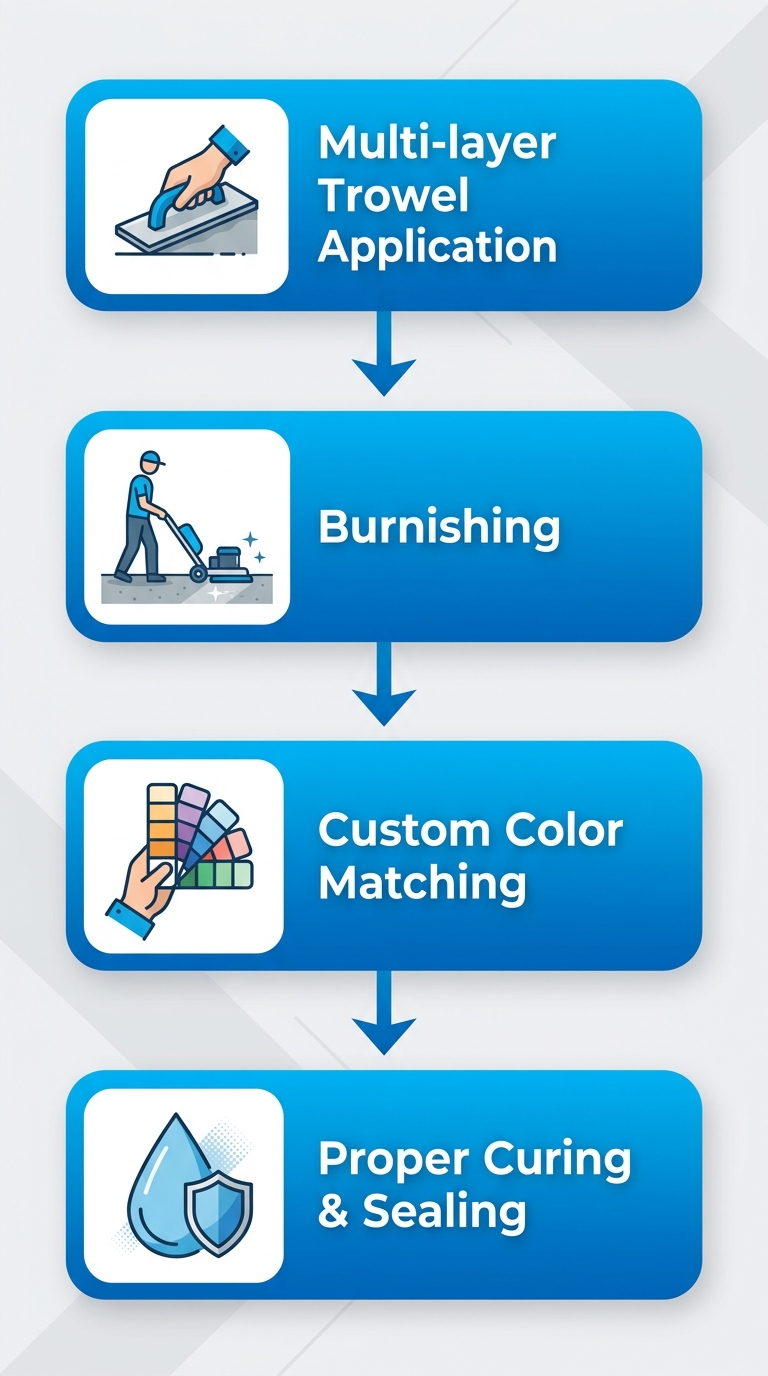
The following table breaks down how specific advanced techniques influence durability and mildew resistance:
| Technique | Effect on Durability & Mildew Resistance | Application Detail |
|---|---|---|
| Multi-layer Trowel Application | Builds density, reduces porosity | Successive thin coats smoothed with steel trowels |
| Burnishing | Compresses surface, enhances water beading | Polishing with stone or hard trowel after application |
| Custom Color Matching | No impact on durability, enhances aesthetic consistency | Tinting lime putty or microcement with mineral pigments |
| Proper Curing & Sealing | Critical for waterproofing integrity and mildew prevention | Controlled moisture cure, application of penetrating sealers |
Multi-layer trowel application, a foundational method in Venetian plaster and microcement installation, involves successive thin coats smoothed with steel trowels. This layering builds density and helps reduce porosity, creating a less absorbent substrate. Burnishing--polishing the cured surface with a stone trowel or hard pad--further compresses the plaster and enhances water beading when properly sealed. Custom color matching, achieved by tinting lime putty or microcement with mineral pigments, ensures aesthetic consistency without altering durability. Proper curing and sealing are considered critical for any waterproof plaster system: a controlled moisture cure followed by penetrating sealers helps prevent moisture intrusion and mildew growth over time. In our experience, executing these techniques effectively requires the practiced hand of a skilled faux finisher.
Over the past decade, we have applied these advanced methods across more than 350 completed tadelakt and micro cement showers in Los Angeles, helping produce durable, mildew-resistant finishes. Results may vary based on materials, substrate, and workmanship. We recommend obtaining an on-site inspection and a written estimate before relying on website descriptions. For projects in pre-1978 properties, it is important to follow EPA Renovation, Repair and Painting (RRP) lead-safe work practices and to use certified contractors where required.
Frequently Asked Questions About Plaster Finishes and Faux Finishers
Homeowners often have a few questions before scheduling a consultation.
What is a faux finisher? A faux finisher uses paint techniques to replicate stone, but we install authentic lime-based plasters like microcement and tadelakt.
How does an authentic plaster finish differ? Unlike a faux finisher, we trowel lime, marble dust and pigments to create waterproof, mildew-resistant surfaces.
Is Venetian plaster suitable for showers? Venetian plaster and micro cement showers act as waterproof plaster systems, ideal for shower walls, floors and countertops.
Is tadelakt plaster truly waterproof? Tadelakt plaster's burnished surface forms a non-porous barrier. With over 350 tadelakt showers completed in Los Angeles, these finishes resist mildew. Results may vary based on materials, substrate and workmanship.
Do you serve Los Angeles and how do we start? We provide on-site inspections and written estimates throughout Los Angeles. As a local Los Angeles company, we tailor finishes to area homes. Contact us to schedule a consultation; please obtain an on-site inspection and written estimate before relying on website descriptions.
Your Path to a Beautiful, Waterproof Plaster Shower in Los Angeles
As an experienced faux finisher in Los Angeles, we transform ordinary showers into seamless, waterproof plaster retreats. Over 350 showers and ten years of experience back our use of authentic lime putty and marble dust for Venetian plaster and microcement finishes. The process: a thorough on-site inspection, a custom written estimate, and meticulous installation that brings your vision to life. When installed correctly over a sound substrate, these plaster surfaces resist moisture exceptionally well. For pre-1978 homes, we follow EPA RRP lead-safe practices. Request your inspection and estimate to start your path to a waterproof plaster shower.
